
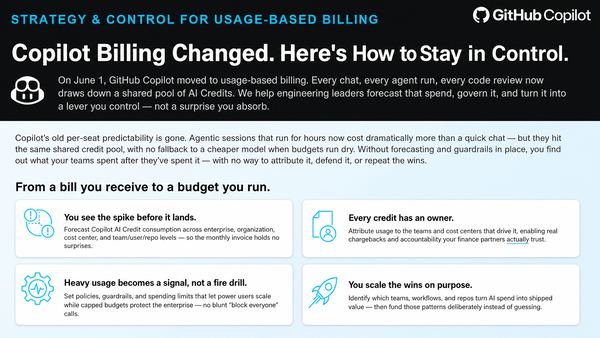
How to maximize AI-powered developer productivity while maintaining visibility, accountability, and cost control.
On June 1, 2026, GitHub officially shifted Copilot Business and Enterprise customers from Premium Request Units (PRUs) to Usage-Based Billing (UBB). During a temporary promotional period ending September 1, customers receive increased AI Credit allocations before standard credit limits take effect.
While the change may appear to be a pricing update, it actually represents something much larger: the transition from predictable AI licensing to consumption-driven AI operations.
For organizations embracing GitHub Copilot, agentic development, and AI-assisted software delivery, understanding Usage-Based Billing has quickly become a strategic priority.
What Changed?
Under the old model, GitHub Copilot usage was largely governed by Premium Request Units (PRUs), providing a relatively predictable consumption framework.
Today, GitHub measures usage through AI Credits, which are consumed based on actual AI activity, including model selection, token consumption, and workload complexity.
In practical terms, not all Copilot interactions are created equal.
For example:
- A pull request review using a lightweight model may consume approximately 1 credit.
- The same review using a frontier model such as Claude Sonnet may consume approximately 17 credits.
- A 60-minute agentic development session spanning multiple files may consume hundreds of credits depending on model selection and workload complexity.
Organizations are no longer simply purchasing access to AI. They are now managing AI consumption.
Does This Affect Developers Using VS Code?
Yes.
If your teams use GitHub Copilot within Visual Studio Code, Usage-Based Billing applies to many common AI-assisted development activities, including:
- Copilot Chat
- Agent Mode
- Repository analysis
- Multi-step development workflows
- AI-powered code reviews
- Autonomous coding sessions
However, standard code completions and Next Edit Suggestions remain included and do not consume AI Credits.
For many organizations, this distinction is critical. Traditional code completion usage often remains relatively inexpensive, while agentic AI workflows can become meaningful cost drivers as adoption grows.
Why GitHub Made the Change
GitHub Copilot has evolved significantly beyond code suggestions.
Today's platform enables developers to:
- Analyze repositories
- Generate solutions
- Review code
- Refactor applications
- Execute agentic workflows
- Collaborate with increasingly capable AI models
These advanced capabilities consume substantially more compute resources than traditional coding assistance. GitHub's new billing model aligns costs more closely with actual consumption while supporting the continued evolution of AI-powered software development.
Three Questions Every Organization Should Ask
1. Do We Have Visibility Into Copilot Consumption?
Under PRUs, forecasting was relatively straightforward.
With Usage-Based Billing, consumption varies based on:
- User behavior
- Team adoption
- Workflow complexity
- Model selection
Without proper reporting and monitoring, organizations often discover spending trends only after credits have already been consumed.
2. Are We Using the Right Models for the Right Jobs?
One of the largest variables in AI spend is model choice.
Not every task requires a frontier model.
Organizations often benefit from creating guidance around:
- Lightweight models for routine coding tasks
- Advanced models for architecture and complex reasoning
- Agentic workflows for high-value use cases
The difference between models can have a significant impact on monthly AI consumption.
3. Can We Prove AI ROI?
As AI spending becomes more visible, leadership teams increasingly want answers to questions such as:
- Which teams generate the most value?
- Which repositories benefit the most from AI?
- Which workflows improve developer productivity?
- Where should additional investment be directed?
Organizations that can connect AI spend to business outcomes will be in a much stronger position than those simply tracking consumption.
The Bigger Shift: AI Spend Is Becoming an Operational Discipline
GitHub's move to Usage-Based Billing reflects a broader trend across the software industry.
AI is no longer just assisting developers.
It is increasingly:
- Planning work
- Executing tasks
- Reviewing code
- Generating solutions
- Driving autonomous workflows
As agentic development becomes more common, engineering leaders must balance innovation with governance.
The challenge is no longer whether teams will use AI.
The challenge is ensuring that AI adoption scales responsibly, predictably, and profitably.
From a Bill You Receive to a Budget You Run
The biggest risk with Usage-Based Billing isn't necessarily higher costs.
It's the lack of visibility.
Without forecasting, attribution, and governance, organizations often struggle to answer simple questions:
- Who consumed the credits?
- Which teams generated the spend?
- Which projects benefited?
- Which budgets should absorb the costs?
By the time those questions arise, the credits have already been spent.
That's why leading organizations are beginning to treat AI consumption the same way they treat cloud consumption—with reporting, accountability, governance, and financial controls.
Introducing InCycle's Usage-Based Billing Strategy & Control Engagement
InCycle's Usage-Based Billing Strategy & Control offering helps organizations gain visibility into GitHub Copilot consumption, implement governance, and scale AI adoption with confidence.
Our goal is simple:
Help organizations forecast, govern, optimize, and justify GitHub Copilot spending before usage becomes a budget surprise.
What We Help You Achieve
Forecast Consumption Before the Invoice Arrives
Understand AI Credit usage across:
- Enterprise
- Organizations
- Cost centers
- Teams
- Individual users
- Repositories
With accurate forecasting, monthly invoices become predictable rather than reactive.
Create Ownership and Accountability
Every credit should have an owner.
We help implement:
- Cost allocation frameworks
- Chargeback models
- Budget controls
- Spending guardrails
- Governance policies
So engineering and finance teams can work from the same set of facts.
Scale AI Adoption Intentionally
Heavy usage should become a signal—not a fire drill.
Our approach helps identify:
- High-performing teams
- High-value workflows
- Successful repositories
- Effective AI investments
Allowing organizations to scale proven successes while reducing waste.
Our Three-Step Approach
1. Baseline & Forecast
We deploy reporting and forecasting capabilities across enterprise, organizational, team, user, and repository levels to establish a clear consumption baseline.
2. Govern & Allocate
We implement policies, spending limits, guardrails, and chargeback structures aligned to your organization's funding and operating model.
3. Optimize & Scale
Through strategic office hours and ongoing advisory support, we help teams reduce waste, defend AI investments, and expand the workflows delivering measurable value.
Why Act Now?
Current Copilot Business and Enterprise customers are operating under temporary promotional AI Credit allocations that expire on September 1, 2026. After that date, included credit levels return to their standard allotments.
Organizations that establish visibility and governance now will be far better prepared to:
- Forecast future spending
- Manage budgets proactively
- Optimize model usage
- Support broader AI adoption
- Demonstrate ROI to leadership
The sooner you understand your consumption patterns, the easier it becomes to scale AI successfully.
Book a 30-Minute Cost Control Review
If your organization is using GitHub Copilot Business or Enterprise, now is the ideal time to assess your Usage-Based Billing readiness.
 During this complimentary review, we'll discuss:
- Your current Copilot consumption model
- Potential impact of the September credit reduction
- Governance and accountability strategies
- Budget controls and forecasting opportunities
- Whether Microsoft funding may be available to support the engagement
Your AI spend is now a P&L line item. Treat it like one.
Book a 30-minute Cost Control Review and learn how InCycle can help you turn GitHub Copilot spending into a managed business asset—not a budget surprise.